 1800-103-7261
  hello@myndfin.com
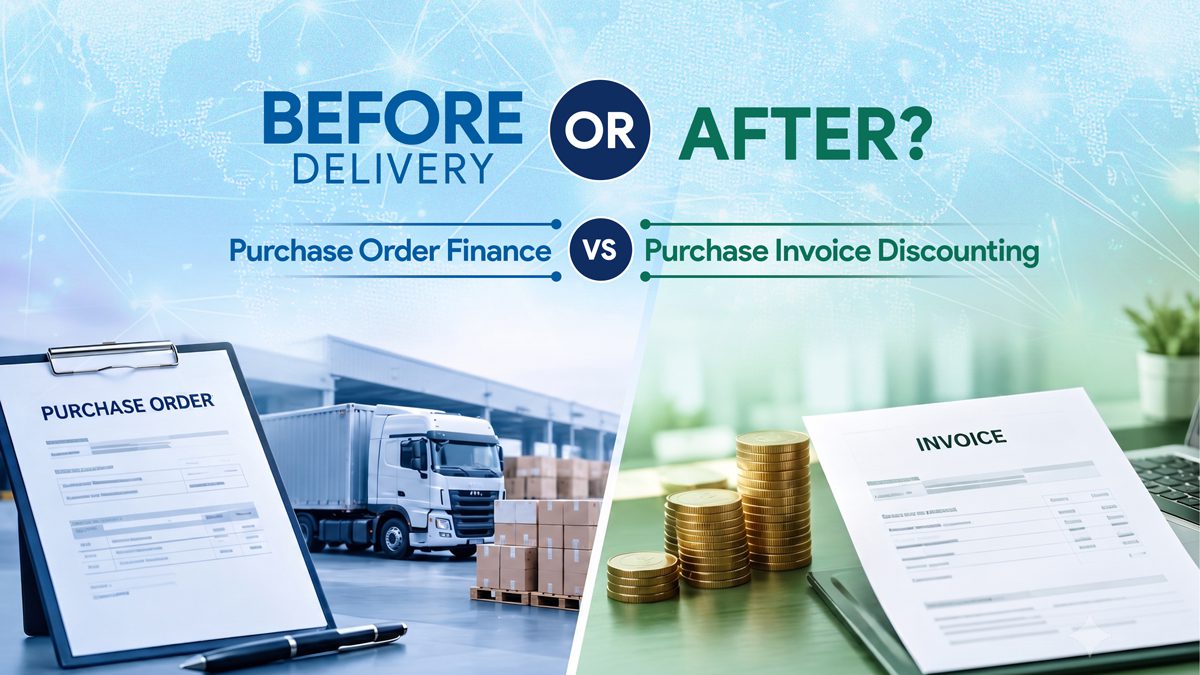
A supplier wins one of its largest orders of the year. For the buyer, the purchase order begins a procurement cycle. For the supplier, it can create an immediate cash requirement.
The supplier must purchase materials, reserve production capacity, and arrange logistics before it can deliver and raise an invoice. Then a second gap may appear: the work is complete, but payment is still 30, 60, or 90 days away.
Purchase Order Finance and Purchase Invoice Discounting address these two different moments. One provides funding before delivery. The other releases cash after delivery and invoice approval.
For an enterprise buyer, the choice starts with a practical question: when does cash prevent a capable supplier from moving forward?
One transaction can create two funding needs.
A confirmed order gives a supplier visibility of future revenue, but not the money required to fulfill it. This is the pre-shipment requirement: funding is needed before the supplier has created a receivable.
After delivery, the financial position changes. The supplier can raise an invoice, but the cash it represents remains unavailable until the buyer pays. This is the post-delivery requirement.
The distinction matters because the financier relies on different evidence at each stage. Before delivery, it evaluates whether the supplier can complete the order. After invoice approval, the focus shifts towards the buyer’s confirmed payment obligation.
Purchase Order Finance supports fulfillment.
Purchase Order Finance is a form of pre-shipment funding that helps a supplier meet the cost of completing a confirmed order.
In practice, anchor buyers can make pre-shipment finance easier to assess by issuing verified digital purchase orders through platforms such as Mynd Fintech. Reliable order data helps financiers evaluate requests and enables Tier-1 and Tier-2 suppliers to seek capital for materials, production and logistics before dispatch.
The purchase order shows that demand exists. It does not prove that the supplier will manufacture and deliver successfully. A financier may therefore assess the order, contract, production schedule, expected margins, supplier quotations, and the supplier’s record with similar work.
Funding may cover raw materials, manufacturing, packaging, or other fulfillment expenses. Depending on the arrangement, the supplier may receive funds in stages or be paid directly by the buyer.
This becomes valuable when a supplier receives an attractive order that is much larger than its usual business. Without additional working capital, it may have to delay production, request an advance, or decline part of the order.
Purchase Invoice Discounting starts after delivery.
Purchase Invoice Discounting—often structured as Purchase Bill Discounting or post-shipment Invoice Financing—applies once the supplier has delivered, raised an invoice, and received the buyer’s approval.
Instead of waiting for the due date, the supplier receives payment earlier through a financing provider. The applicable financing charge is deducted, and the financier pays the balance to the supplier.
At this point, the financier is no longer assessing whether the supplier can complete the order. The financier’s focus shifts from supplier operational risk to the approved receivable, the buyer’s superior credit rating, and the invoice tenor. Invoice approval is therefore critical. Delivery alone may not make a receivable finance-ready. Missing goods receipt records (GRN), pricing mismatches, and unresolved credit notes often delay approval—which is why automated 3-way matching in enterprise ERPs is critical to making an invoice finance-ready.
Purchase Invoice Discounting works best when the buyer has a disciplined approval process and can share dependable payment information with the financing provider.
Delivery changes the risk.
Purchase Order Finance is provided while performance risk remains. Production can be delayed, input costs can change, inspections can fail, and the order can be amended.
These risks influence how much a financier will provide, what documents it requires, and how closely it controls fund use.
After delivery and approval, much of that uncertainty has been resolved. That can give a financier a clearer basis for evaluating Purchase Invoice Discounting, although payment delays, deductions, disputes and fraud can still affect the receivable.
The difference is not merely timing. Each facility depends on a different transaction trigger and carries a different combination of risks.
| Parameter | Purchase Order Finance | Purchase Invoice Discounting |
| Stage | Pre-shipment | Post-delivery |
| Trigger document | Purchase order | Approved invoice / GRN |
| Underwriting focus | Supplier execution risk | Buyer credit rating |
| Financing cost | Generally higher | Generally lower / credit arbitrage |
| Primary risk | Manufacturing failure | Payment delay |
The enterprise buyer shapes access to both.
The buyer may not supply the funding, but its procurement and payment processes determine whether suppliers can access it efficiently.
For Purchase Order Finance, the purchase order should state what is being purchased, its value, delivery requirements, and payment terms. Frequent amendments or unclear acceptance criteria make an order harder to finance. A financier may also ask the buyer to confirm that the order is genuine and active.
However, buyer order confirmation should never be confused with a performance or repayment guarantee; explicit contract terms must separate buyer obligations from supplier debt liability. In practice, the contract should define measurable milestones—such as production completion, inspection sign-off, and dispatch—and the evidence required for acceptance so that financiers can verify progress without manual disputes.
For Purchase Invoice Discounting, timely invoice approval is the buyer’s most important contribution. Procurement confirms fulfillment, the receiving team records delivery, accounts payable verifies the invoice, and treasury settles it according to the financing arrangement.
When those steps remain disconnected, suppliers spend time chasing status, and finance-ready invoices remain stuck in exceptions.
Documentation and cost follow the funding stage.
Pre-shipment finance needs evidence that the supplier can convert an order into delivery. A financier may ask for the purchase order, contract, cost estimates, raw-material quotations, production milestones, and inspection requirements. The supplier must explain how the funding will be used.
Post-delivery invoice finance relies more heavily on the invoice, proof of delivery, buyer approval, due date, and details of deductions or credit notes. The supplier still completes onboarding and selects invoices, but it usually provides less production information because fulfillment has already occurred.
Cost reflects this difference. Purchase Order Finance can be more expensive because money is advanced while performance risk remains. Purchase Invoice Discounting may be priced more competitively after approval, particularly when a buyer-led program allows the financier to consider the anchor’s credit profile.
Neither assumption should replace a full comparison. Supplier and buyer should examine the amount advanced, financing days, fees, recourse terms, and the impact on the supplier’s margin.
The commercial outcome matters too. Pre-shipment funding may enable an order that could not otherwise be fulfilled. Post-delivery financing may reduce the supplier’s borrowing pressure or help it accept the next order sooner. The lowest rate has little value if funding arrives after the real cash constraint has passed.
Repayment must be clear from the start.
In a typical Purchase Order Finance arrangement, the supplier receives funding and remains responsible for repayment under the facility agreement. The financier may require the buyer’s eventual payment to flow into a specified account, but that does not automatically transfer the supplier’s debt to the buyer.
With Purchase Invoice Discounting, repayment is linked to the financed receivable. The buyer may pay the financier directly on the due date, or the supplier may collect the payment and settle the facility.
The agreement should also state whether finance is with or without recourse. Under a recourse structure, the supplier may remain liable if the buyer does not pay. A non-recourse facility may transfer defined payment risks, but exclusions can still apply.
Product labels do not establish who carries the risk. The contract does.
Choose the point of intervention, not just the product.
Enterprise teams should begin with supplier behavior.
Are suppliers asking for advances, delaying material purchases, or declining larger orders despite having operational capacity? Those are signs that pressure exists before shipment. Purchase Order Finance may address it directly.
Can suppliers fulfill orders but regularly ask for shorter payment terms? Do approved invoices sit unpaid while suppliers borrow elsewhere? The pressure is post-delivery, making Purchase Invoice Discounting a better fit.
System readiness also matters. Pre-shipment finance needs reliable purchase-order data and visibility of amendments or cancellations. Post-delivery finance needs timely approval and accurate information about due dates, disputes, and deductions.
The supplier base may lead to a blended approach. Purchase Order Finance can be targeted at suppliers handling large or strategically important orders. Purchase Invoice Discounting can often serve a broader base once invoice approval is consistent.
Some supply chains need both.
A supplier may use Purchase Order Finance to begin production and Purchase Invoice Discounting after delivery. Together, the facilities can support the transaction from confirmed order to buyer payment.
Coordination is essential. The parties need a clear record of when the order was funded, when delivery occurred, and when the invoice became eligible for discounting. This prevents the same transaction from being financed twice.
An end-to-end supply chain finance platform such as Mynd Fintech can integrate directly with the buyer’s ERP, automate the flow of purchase orders, delivery records, approvals, and financing eligibility, and provide real-time tracking of transaction and funding status. This creates a common view without replacing the financier’s credit decision.
Begin with the supplier’s cash-flow cycle.
Purchase Order Finance and Purchase Invoice Discounting solve different problems within the same commercial cycle.
If a supplier has an order but lacks the funds to fulfill it, financing must begin before shipment. If it has delivered but must wait for payment, post-delivery finance releases cash from the approved receivable.
Identify that moment first. The right financing structure should meet the supplier where the cash gap begins and support the commercial result the enterprise wants to protect.
If supplier liquidity is constraining procurement, connect with the Mynd Fintech team to identify where the cash-flow gap occurs from purchase order to approved invoice and design a digital program around your existing processes.
Frequently asked questions
What is Purchase Order Finance?
Purchase Order Finance is pre-shipment funding against a confirmed purchase order. It helps a supplier pay costs such as raw materials, production, and packaging before delivery.
What is Purchase Invoice Discounting?
Purchase Invoice Discounting allows a supplier to receive payment against an invoice before its contractual due date, generally after delivery and buyer approval.
What is the difference between pre-shipment and post-delivery finance?
Pre-shipment finance supports order fulfillment before a receivable exists. Post-delivery finance releases cash after the order is complete and the invoice is approved.
Is Purchase Invoice Discounting always cheaper?
No. It may be priced more competitively after buyer approval, but cost still depends on tenor, transaction value, buyer and supplier profiles, facility terms and market conditions.
Who repays Purchase Order Finance?
The supplier usually remains responsible under the financing agreement. Routing the buyer’s payment to the financier does not automatically make the buyer liable for the supplier’s debt.
Can a supplier use both facilities?
Yes. Pre-shipment funding can support fulfillment, and post-delivery financing can release cash from the resulting invoice. The facilities must be coordinated to prevent duplicate financing.
Does Purchase Invoice Discounting impact the buyer’s balance sheet or credit limits?
Usually, financing is extended to the supplier against an approved receivable, so it does not automatically become buyer borrowing or consume the buyer’s bank limits. Treatment depends on the program structure, guarantees, contractual obligations, and applicable accounting standards, and the buyer’s advisers should confirm it.
