 1800-103-7261
  hello@myndfin.com
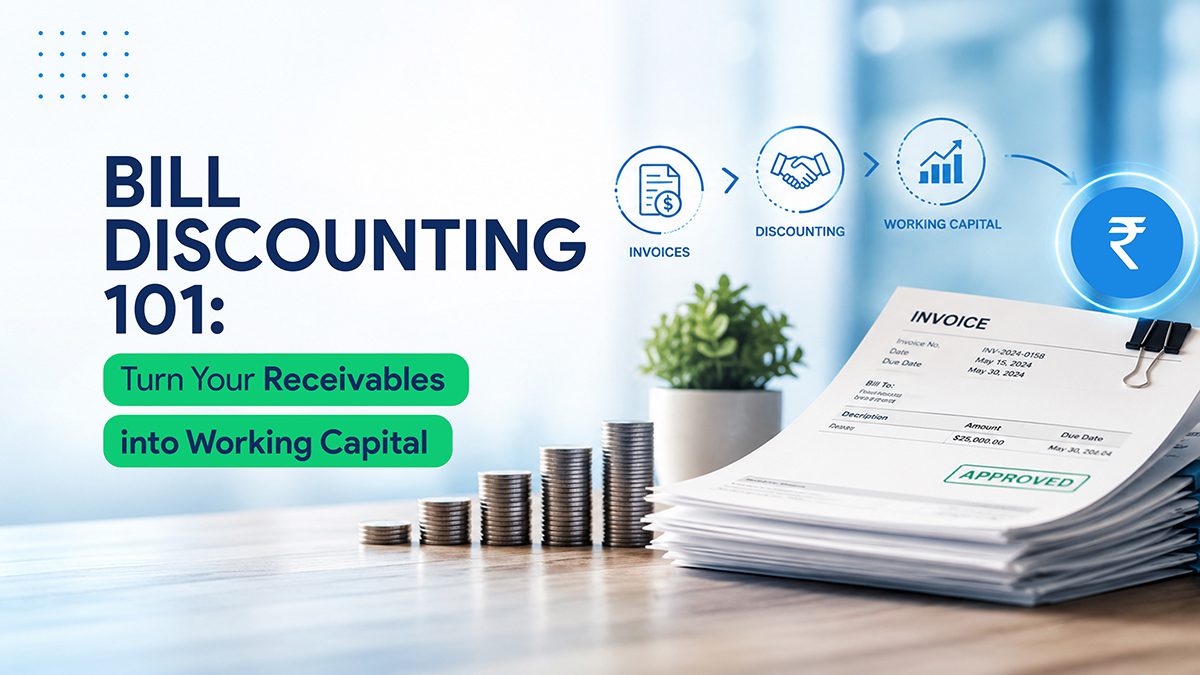
Bill Discounting: Put Your Receivables to Work
A sale may be complete, but the cash can still feel out of reach. The goods are delivered, the invoice is raised, and the revenue is booked. Meanwhile, suppliers, salaries, and the next production run all need funding.
That is where bill discounting comes in. It allows a business to use an eligible receivable to access working capital sooner, subject to verification, pricing, and the facility terms. In other words, it puts money already earned back to work.
The idea is simple. The details matter. Who starts the financing? Who receives the money? Who pays the financier? And what happens if the buyer does not pay? Those answers tell you far more than the product name.
Bill Discounting, in Plain English
At its simplest, bill discounting is short-term financing secured by an eligible bill, invoice, or receivable. The financier reviews the transaction, approves the funding, and collects payment in accordance with the agreed structure.
For the supplier, the benefit is practical: a completed sale can support today’s business needs. The cash can fund procurement, production, supplier payments, payroll, or the next order, rather than sitting idle in receivables.
A well-structured non-recourse arrangement can do more than accelerate cash. Where it transfers all the risks and rewards of the receivable substantially to the financier, the receivable may qualify for derecognition. In that case, the business is monetizing an asset rather than recording the proceeds as a borrowing liability. That is different from a traditional working capital loan, cash credit (CC) or overdraft (OD), which ordinarily creates a financial liability. The outcome is not automatic: recourse, continuing involvement, control, contract terms and the applicable accounting framework must be assessed for the specific arrangement.
How Bill Discounting Works
Step 1: The Buyer Places an Order
The buyer issues a purchase order (PO) setting out the agreed quantity, price, delivery terms and payment date. The trade has begun, but there is no receivable to finance until the supplier fulfills the order and raises an eligible invoice.
Step 2: The Supplier Delivers
The supplier fulfills the order. Once the goods or services are accepted, the supplier has the basis to raise an invoice under the contract.
Step 3: The Invoice Is Raised and Approved
The supplier raises the invoice. It can then be matched with the purchase order, delivery records, buyer approval, tax details, and the program’s eligibility rules.
Step 4: The Financier Releases Funds
Once the transaction passes the checks, the financier releases the agreed amount under the facility. The exact advance and deductions depend on the contract.
Step 5: The Buyer Pays on the Due Date
The buyer pays through the route set out in the arrangement. The financier then closes or adjusts the transaction, deducts the agreed charges, and releases any balance where applicable.
A Quick Example
Suppose a manufacturer delivers components worth ₹25 lakh and raises an invoice payable at a later date. Once the buyer confirms the invoice and the financier completes its checks, the manufacturer receives the agreed funding amount.
Now the manufacturer can put that cash into raw materials or production. On the due date, the buyer pays under the agreed structure, and the financier completes settlement. The advance, fees, payment route and recourse still depend on the contract.
Trade Bill Discounting vs Purchase Invoice Discounting
Here is the easiest way to separate the two: trade bill discounting is usually led by the supplier against a receivable. In contrast, purchase invoice discounting is usually arranged by the buyer against an approved payable.
| Question | Trade bill discounting | Purchase invoice discounting |
|---|---|---|
| Who usually drives it? | The supplier or holder of the eligible receivable. | The buyer or anchor under a purchase-side program. |
| What supports financing? | An eligible trade bill, invoice, or receivable before maturity.
An eligible sales invoice or trade bill drawn by the supplier. |
An approved purchase invoice or payable under the program.
An approved purchase invoice or payable under a buyer-led Supply Chain Finance (Reverse Factoring) program. |
| Who gets paid early? | The supplier receives earlier liquidity. | The supplier is paid under a buyer-arranged structure. |
| Whose credit is central? | The buyer’s credit, the transaction, and the recourse terms are assessed. | The buyer’s credit profile and program terms are often central. |
| Who settles on the due date? | The buyer pays through the agreed route. | The buyer repays or settles with the financier as agreed. |
Labels vary across banks, NBFCs and digital platforms. So look under the bonnet: confirm who applies for funding, who must pay, where the money moves, who carries the risk and how the transaction is recorded.
Digital Bill Discounting – Connected, Automated, Seamless
Email chains, spreadsheets and repeated data entry can turn a straightforward transaction into a relay race. A digital workflow brings procurement, finance, treasury, and the financing partner into a single controlled process.
Connected data: Purchase orders, delivery records, invoices, approvals, and payment status can be linked.
Clearer status: Teams can see where a transaction is pending and what information is missing.
Fewer handoffs: Structured data can reduce repeated document exchanges and manual rekeying.
Stronger controls: Validation rules, approval trails and exception handling can be built into the workflow.
Easier reconciliation: Financing, due-date payments and settlement records can be tracked together.
Technology can speed up the route; it does not skip the checks. Underwriting and documentation still matter, but the process can become more consistent and easier to track.
Why ERP Integration Matters?
Direct API-based connectivity with enterprise ERPs (such as SAP, Oracle, Microsoft Dynamics, and Tally Prime) automatically fetches e-invoices, e-way bills, Goods Receipt Notes (GRNs), and digital approval statuses directly into the financing workflow.
By comparing purchase orders, tax identifiers, and duplicate records via automated 3-way matching, clean transactions move from verification to approval in minutes rather than days, eliminating manual data re-entry while routing genuine discrepancies to the right team for exception handling.
The platform can compare invoice numbers, purchase orders, buyer and supplier details, amounts, dates, approvals, and duplicate records.
The payoff is a clearer path from approval to disbursal and settlement, with a stronger audit trail along the way. Speed still depends on data quality, program rules, and the financing partner’s approval process.
Where Bill Discounting Helps Most
Bill discounting works best when the sale is complete, the buyer is acceptable, and the invoice is sound. It brings cash forward so operating expenses do not have to move in lockstep with the collections cycle.
- Fund raw materials or production for confirmed demand
- Pay suppliers while customer invoices remain outstanding
- Support payroll and short-term operating requirements
- Take on new orders without stretching the existing cash cycle
- Reduce dependence on ad hoc collections for day-to-day liquidity
A quick reality check: Bill discounting cannot fix disputed invoices, weak margins or poor collections. If the buyer may reject the invoice, the cost eats too deeply into the margin, or every receivable must be discounted to cover losses, the business has a different problem to solve.
Bill Discounting vs. Invoice Discounting: Same Thing?
Short answer: they are often used in similar ways, but they are not always identical. Traditionally, a trade bill refers to a bill of exchange or a similar payment instrument, whereas invoice discounting focuses on an eligible invoice or receivable.
In a digital program, the labels may overlap. Rather than debate the wording, ask what creates eligibility, who has recourse, who controls collections, where the buyer pays, and which risks stay with the business.
What Does It Cost?
The quoted rate is not the whole bill. A facility typically includes the discounting charge (calculated strictly pro-rata for the credit period, such as 30, 60, or 90 days), platform or processing fees, documentation charges, and applicable taxes.
Pricing depends on multiple factors, including buyer credit, time until payment, transaction size, recourse, documentation, and program volume. Compare the total rupee cost over the financing period, not one number in isolation.
Before You Choose a Facility: Eight Questions to Ask
Eligibility: Which invoices, buyers, sectors, payment periods and supporting documents qualify?
Funding mechanics: How much of an approved invoice is funded, when is it disbursed and to whom?
Total cost: Which financing, platform, processing, tax and exception charges apply?
Recourse: What happens if the buyer pays late, disputes the invoice or does not pay?
Payment route: Does the buyer pay the business, a controlled account or the financier directly?
Control and visibility: Who handles collections, exceptions, settlement and reconciliation?
Technology: Can the platform integrate with the ERP system while preserving a usable audit trail?
Accounting and legal treatment: How will the arrangement be classified under the relevant contract and reporting framework?
How Mynd Fintech Can Help
Mynd Fintech brings receivables and payables finance onto a single digital supply chain finance platform. It supports supplier-led Sales Invoice Discounting as well as buyer-led Reverse Factoring and Dynamic Discounting programs, allowing businesses to choose a structure that fits where cash is getting stuck and who should lead the financing.
The workflow can run end-to-end, from invoice generation and ERP/API data capture to digital verification, approval, disbursal tracking, and auto-reconciliation. Multi-funder digital bidding brings financing partners into a competitive process, helping eligible transactions access optimal discounting rates while finance teams retain real-time visibility and an audit-ready trail.
Ready to optimize your working capital without adding balance-sheet debt? Explore Mynd Fintech’s digital supply chain finance solutions and request a platform demo today.
Frequently Asked Questions
What is bill discounting?
It is short-term finance against an eligible trade bill, invoice, or receivable. The facility terms set the exact eligibility, pricing, payment flow, and recourse.
How does bill discounting work?
The invoice is verified and approved; the financier releases the agreed amount; and the buyer pays via the specified route on the due date. The financier then settles the transaction under the contract.
What is the difference between trade bill discounting and purchase invoice discounting?
Trade bill discounting is usually supplier-led and linked to a receivable. Purchase invoice discounting is usually buyer-led and linked to an approved payable. Whatever the label, confirm who applies, who gets paid, who repays, and who carries recourse.
How much does bill discounting cost?
It depends on buyer credit, time until payment, recourse, transaction size, program volume, and the financing partner. Compare the full cost, including platform, processing, tax, and exception charges.
Is bill discounting a loan or off-balance-sheet finance?
It depends on the structure. A qualifying non-recourse transfer may allow the receivable to be derecognized, so that the proceeds reflect the monetization of an asset rather than a new borrowing. If the business retains substantial risk or continuing involvement, the arrangement may instead be treated like financing secured by the receivable. Finance, accounting and legal teams should assess the specific contract and reporting framework.
Can ERP integration make bill discounting faster?
Yes. API-based ERP connectivity can pull purchase orders, e-invoices, e-way bills, GRNs and digital approval status directly into the financing workflow. For clean eligible transactions, this can reduce turnaround time from days to minutes, although exceptions, data quality, program rules and financier approval still affect the final timeline.
Is bill discounting the same as factoring?
Not necessarily. Bill discounting mainly provides finance against a receivable. Factoring can also include collections, ledger management and receivables administration, depending on the arrangement.
