 1800-103-7261
  hello@myndfin.com
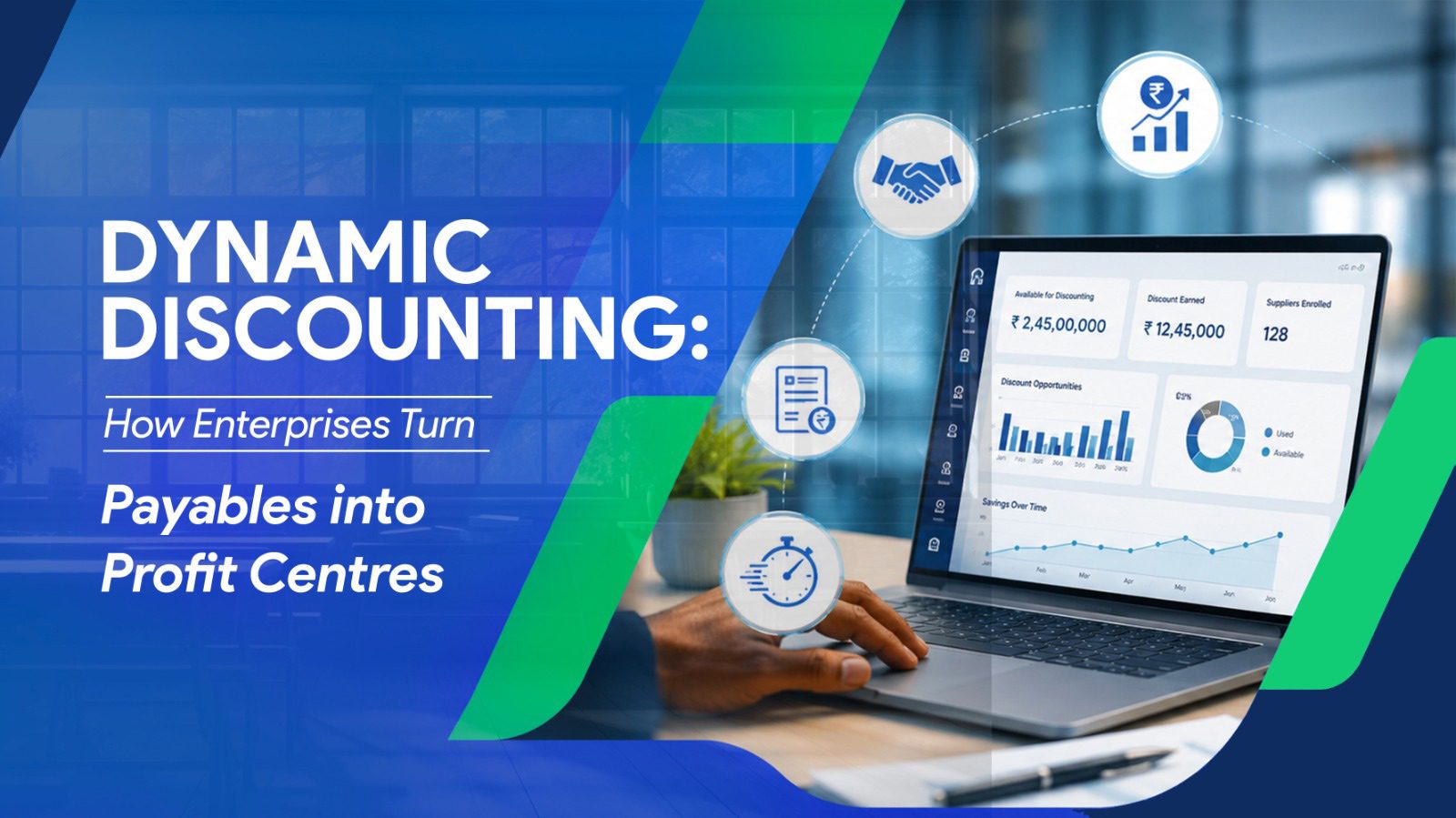
Payables have traditionally been treated as a housekeeping function: receive the invoice, check it, approve it and pay it on the due date. Necessary? Absolutely. Strategic? Not usually.
Dynamic discounting changes that conversation. It gives enterprises a way to use surplus cash more productively while offering suppliers something they value just as much: faster, predictable access to money they have already earned.
The idea is simple. A supplier agrees to a discount in return for receiving an approved invoice early. The earlier the payment, the larger the discount. The buyer captures savings, the supplier improves cash flow, and accounts payable begins to contribute measurable value rather than merely processing transactions.
For enterprises exploring Dynamic Discounting, that combination is especially relevant. Large buyers often sit at the center of supplier networks with very different cash-flow needs. Modern supply chain finance platforms such as Mynd Fintech let treasury teams centrally configure cash-deployment rules, return thresholds, and sliding discount curves. At the same time, suppliers can opt in on an invoice-by-invoice basis. That makes the program scalable without adding operational friction to accounts payable.
What is Dynamic Discounting?
Dynamic discounting is an early-payment arrangement in which the discount varies based on when an invoice is paid.
Unlike a fixed discount such as “2% if paid within 10 days,” the rate varies over an agreed-upon payment window. If a supplier requests payment well before the original due date, the buyer receives a larger discount. If the supplier waits until closer to the due date, the discount becomes smaller. If early payment is not selected, the invoice is subject to its normal payment terms.
That flexibility is what makes the model dynamic. Suppliers are not forced into a permanent price reduction, and buyers do not have to pay every invoice early. Each eligible invoice becomes an opportunity, not an obligation.
How Does Dynamic Discounting Work?
The process begins only after the buyer has received and approved an invoice. That detail matters. Approval signals to the supplier that the commercial checks are complete and provides the buyer with a reliable basis for offering early payment.
The platform then shows the supplier an early-payment offer. It tells them how much they will receive on a particular date and what discount will apply. The supplier can accept the offer or leave the invoice untouched.
If the offer is accepted, the payment instruction moves through the buyer’s usual approval and control framework. The supplier receives the agreed amount early, while the buyer records the discount as a saving.
Behind this apparently simple experience, a good platform is doing a fair amount of work. It reads invoice and due-date information from the enterprise resource planning system, checks eligibility, calculates the discount, captures the supplier’s consent, triggers approvals, and reconciles the final payment.
Earlier Payment, Higher Discount
Consider this scenario: an approved invoice for ₹1 crore from a supplier not covered by the MSMED Act’s 45-day payment ceiling is due in 60 days. The supplier would like to be paid on day 15, which means the buyer is paying 45 days early.
If the agreed annualized discount rate is 10%, a simple calculation would be:
Discount = ₹1 crore × 10% × 45 ÷ 365
The buyer’s saving is approximately ₹1,23,288, and the supplier receives approximately ₹98,76,712 on day 15.
Tax note for Indian transactions: the illustration reflects no GST or tax adjustments. A post-supply discount can reduce the GST value only when the conditions in Section 15(3) of the CGST Act are met, including a pre-existing agreement, linkage to the relevant invoice and proportionate reversal of input tax credit. Otherwise, the parties may use a commercial or financial credit note without reducing the original GST liability. CBDT guidance generally excludes ordinary sales discounts, cash discounts and rebates from TDS under Section 194R, but the exact documentation and tax treatment should be confirmed for the transaction.
Now imagine the same supplier requests payment only 15 days before the due date. The discount falls to approximately ₹41,096 because the buyer is parting with its cash for a much shorter period.
This sliding scale creates a fair commercial exchange. The buyer is rewarded in proportion to how early it pays, and the supplier gives up only as much margin as needed to cover the time gained.
For registered micro and small enterprise suppliers covered by the MSMED Act’s delayed-payment provisions, the original payment term should not exceed 45 days from acceptance or deemed acceptance. Dynamic Discounting can bring payment forward within that compliant window, helping corporates protect payment discipline while capturing an early-payment discount.
The exact curve can be configured. Some programs use a straight-line annualized rate; others use tiers or different rates for supplier groups. What matters is transparency. Suppliers should be able to see the net payment and date before accepting, without needing a calculator or a call to the accounts payable team.
Whose Cash Funds the Early Payment?
This is where dynamic discounting differs from many supplier-finance structures: the enterprise buyer typically uses its own treasury surplus to pay approved invoices early.
For a cash-rich buyer, that can be attractive. Instead of leaving short-term cash idle or placing all of it in market instruments, the treasury team can deploy a controlled portion against genuine, approved payables and earn a return through procurement discounts.
Third-party-funded early payment is conceptually closer to Reverse Factoring or Supply Chain Finance than to pure buyer-funded Dynamic Discounting. A bank or non-bank financier pays the supplier early, and the buyer settles the full invoice with that financier on the original due date. This preserves the buyer’s cash and payment terms while giving the supplier earlier liquidity; the financier earns the financing charge.
Advanced providers can offer Hybrid Dynamic Discounting, switching between the buyer’s surplus cash and multi-bank or financial-institution funding lines based on daily liquidity, return thresholds, and program rules. Suppliers continue to see early-payment options even when treasury cash is tight, while the buyer avoids putting unnecessary pressure on liquidity.
How Payables Becomes a Profit Center
The most visible benefit for an anchor buyer is the return on surplus cash.
If accepted discount curves generate annualized pre-tax savings of 9% to 14% on approved payables, the implied yield can materially exceed an illustrative benchmark of 6.5% to 7.5% for conventional short-term instruments such as 91-day Treasury Bills, high-grade Commercial Paper, bank fixed deposits, or liquid mutual funds. The exact comparison will track market rates and the program’s realized supplier participation.
The return is embedded in settling an already-approved obligation rather than taking market-price risk on a separate investment, which can make it highly predictable. It should not, however, be treated as universally risk-free: invoice validity, disputes, fraud, execution, tax, liquidity and accounting treatment still matter. Treasury teams should compare alternatives on an after-tax, liquidity-adjusted basis and update their hurdle rates as markets change.
The second benefit is stronger supplier liquidity.
Smaller vendors frequently wait weeks for approved invoices to mature while continuing to pay wages, purchase materials and fulfill new orders. Optional early payment can help them bridge that gap without taking an unrelated loan.
That supplier benefit flows back to the buyer. A supplier with healthier cash flow is better placed to fulfill orders, absorb seasonal demand and negotiate with its own vendors. Dynamic discounting is therefore not just a treasury lever. It can support continuity, supplier relationships and procurement resilience.
There is also a process benefit. Once discount rules are digitized, teams no longer have to negotiate one-off early payments, calculate discounts manually, or track approvals across scattered spreadsheets and emails. A governed program replaces exceptions with policy.
The strongest business case captures all three outcomes: financial savings, supplier health and operational efficiency.\
Calculating the ROI
The headline calculation is straightforward:
Annual savings = Eligible spend × Supplier participation × Average discount captured
Suppose an enterprise has ₹500 crore of annual supplier spend eligible for the program. If suppliers choose early payment on 20% of that value, ₹100 crore is discounted.
At an average annualized rate of 9% and an average acceleration of 30 days, the approximate annual saving is:
₹100 crore × 9% × 30 ÷ 365 = approximately ₹74 lakh
That number is useful, but it is not the final business case. Implementation fees, integration effort, internal operating costs and the buyer’s own cost of funds must also be considered. So must seasonality: surplus cash in one quarter may be needed elsewhere in the next.
A sensible ROI view therefore tracks net savings, not just gross discounts. It should also measure supplier participation, offer acceptance, average days paid early, cash deployed and savings by business unit or supplier segment.
Choosing a Dynamic Discounting Provider in India
Start with direct ERP and banking integration. The provider should support enterprise systems and ingest purchase orders, invoices, approval statuses, etc. Ask how direct Host-to-Host (H2H) or API banking connections trigger payments and auto-reconciliation, and how the platform handles multiple ERP instances, business units and master-data changes.
Next, examine onboarding. Can suppliers register digitally? Are tax, bank and identity details validated appropriately? Can smaller vendors complete the journey on a phone, or does the process assume that every supplier has a finance team and a desktop computer?
In India’s varied supplier ecosystem, ease of use is not cosmetic. It directly affects adoption.
Then look at configurability. Your treasury team should be able to set cash budgets, minimum return thresholds, eligible entities and payment windows. Procurement may want different approaches for strategic, long-tail or vulnerable suppliers. The Dynamic Discounting solution should support those policies without turning every adjustment into a technology project.
Controls deserve equal attention. Look for clear user roles, maker-checker workflows, approval limits, audit trails, supplier consent records, and reliable reconciliation. Ask how the provider protects financial and supplier data, manages access and supports your security and compliance reviews.
Do not forget analytics. Decision-makers should be able to see cash deployed, savings captured, supplier participation, rejected offers and payment performance. Better still, the platform should help explain where adoption is weak and which supplier groups present the next realistic opportunity.
Finally, ask for evidence of supplier adoption, not simply the number of suppliers uploaded onto a platform. How many were contacted? How many completed onboarding? How many viewed offers, and how many used them again?
A Dynamic Discounting provider can have sophisticated software and still deliver disappointing ROI if suppliers do not participate.
Supplier Adoption Is the Real Conversion Funnel
For some vendors, the discount will be attractive because it improves cash certainty. For others, waiting until the due date will be the better commercial choice. Both decisions should be respected.
Communication also needs context. A small manufacturer may care about purchasing raw material for its next order. A seasonal supplier may value early payment only during peak months. A larger vendor may compare the discount with its own borrowing cost. The same generic email will not persuade all three.
The best programs make the value easy to understand, the choice easy to exercise, and the support easy to reach.
From Pilot to Scale
Begin with a focused pilot rather than opening the program to every invoice at once. Choose a business unit with clean approval data, meaningful spend and suppliers that are likely to value early payment.
Set success measures before launch: cash deployed, net savings, supplier activation, repeat usage, average payment acceleration and exception rates. Run the pilot long enough to observe behavior, not merely to prove that the software works.
Then learn from it.
If suppliers register but do not accept offers, pricing or communication may be the issue. If offers arrive late, invoice approval is probably the bottleneck. If reconciliation creates manual work, integration needs attention before expansion.
Once the operating model is stable, scale by supplier segment, entity, or geography. Dynamic discounting becomes powerful through repeated, controlled use, not through a dramatic launch announcement.
The Bottom Line
Dynamic discounting gives enterprises a practical way to connect two priorities that are often managed separately: earning more from surplus cash and helping suppliers access liquidity sooner.
The mechanics are simple, but the results depend on execution. The discount curve must meet both parties’ needs. Treasury needs control over cash. Procurement needs supplier participation. Accounts payable needs reliable automation. Suppliers need a transparent, genuinely optional experience.
When those pieces come together, payables stops being merely the place where invoices wait. It becomes a source of measurable savings, stronger supplier relationships and better working-capital decisions.
Ready to transform your accounts payable into a high-yielding profit center? Schedule a custom treasury ROI assessment or platform demo with Mynd Fintech today.
Frequently Asked Questions
What is dynamic discounting in simple terms?
Dynamic Discounting is an automated early-payment program in which an enterprise buyer pays an approved supplier’s invoice before its scheduled maturity date in exchange for a discount. Unlike static terms (e.g., 2/10 net 30), the discount rate dynamically adjusts based on the payment date—the sooner the supplier requests payment, the higher the discount the buyer captures.
How is dynamic discounting different from invoice discounting?
Invoice Discounting: Supplier-led. The vendor borrows against outstanding invoices from a third-party financier, utilizing the supplier’s own credit line.
Reverse Factoring / Supply Chain Finance: Buyer-led, third-party funded. A bank or financial institution pays the supplier early, and the buyer settles the full amount with the bank on the original due date.
Dynamic Discounting: Buyer-led and primarily buyer-funded. The enterprise deploys its own surplus treasury cash against 3-way matched, approved payables to earn a predictable pre-tax return through procurement savings. Advanced platforms can also offer a hybrid model that switches to third-party funding when treasury liquidity is low.
Is participation compulsory for suppliers?
No. Participation is strictly optional. A good platform provides suppliers with a self-service portal showing exact net payout dates and applicable discount rates. Suppliers can choose to discount an invoice when they need immediate working capital or leave it untouched to be settled on the standard payment terms.
Does dynamic discounting reduce the buyer’s DPO?
Paying an invoice early can reduce Days Payable Outstanding for the invoices included in the program. That is an intentional trade-off: the buyer uses cash earlier in return for a discount.
Enterprises can manage the impact by setting cash budgets, return thresholds, supplier eligibility rules and payment windows rather than making every invoice eligible.
Which suppliers are most likely to use dynamic discounting?
Suppliers with seasonal cash needs, long payment cycles, limited access to affordable credit or frequent working-capital gaps may find it particularly useful. However, participation ultimately depends on whether the offered discount is attractive compared with the supplier’s other funding options.
What key features should an enterprise look for in a Dynamic Discounting provider in India?
Frictionless Digital Onboarding: Instant vendor verification via GSTIN, PAN, Penny Drop bank checks, and Aadhaar e-Sign/e-KYC.
Treasury & Policy Controls: Flexible sliding-scale rate curves, dynamic bidding engines, maker-checker workflows, and cash budget caps.
Hybrid Funding Capabilities: Ability to switch between self-funded treasury cash and multi-funder credit lines seamlessly.
Real-Time Analytics: Clear visibility into realized yield, cash deployed, supplier participation, and department-wise savings.
