 1800-103-7261
  hello@myndfin.com

Turning Idle Cash into Strategic Value
Treasury management is no longer limited to cash flow forecasting or maintaining liquidity. In 2026, the focus has shifted toward actively utilizing excess cash to drive business growth and create measurable value. Instead of letting funds remain idle, organizations are now exploring strategic avenues such as short-term investments, debt reduction, and operational expansion to maximize returns and strengthen financial stability.
Yet, a persistent gap remains. Despite working capital optimization efforts, excess cash often sits idle on balance sheets or in low-yield instruments. At the same time suppliers continue to face liquidity bottlenecks, leading to inefficiencies across the supply chain.
Dynamic discounting is catching on as a solution because it works, allowing companies to strategically utilize excess cash, improve supplier relationships, and generate risk-free returns.
What is dynamic discounting?
Dynamic discounting is a flexible working capital solution that enables buyers to deploy surplus cash by making early payments to suppliers in exchange for variable discounts.
Dynamic discounting solutions provide the following:
Unlike traditional early payment programs, dynamic discounting offers:
- Flexible discount rates tied to payment timing
- Real-time liquidity decisions
- Dynamic transaction optimization over static agreements
This essentially turns accounts payable from a cost center into a source of returns.
Dynamic Discounting: Why It Matters More in 2026?
Dynamic discounting India has steadily grown in relevance, driven by evolving financial and operational dynamics
- Rising Cost of Capital:
In recent years, rising interest rates have significantly increased the cost of borrowing for suppliers. With traditional funding options like bank loans becoming increasingly expensive, early payments from buyers have emerged as a more efficient and accessible source of liquidity for suppliers
- Supply Chain Volatility
Due to frequent disruptions to the global supply chain and the ever-changing supplier landscape, there is now emphasis on supply chain reliability and on establishing reliable relationships with suppliers. Timely payment is also an essential component of preserving continuity and increasing supply chain resiliency.
- Treasury Accountability
The Treasurer’s functional activities have expanded beyond liquidity management. Financial Teams, along with the CFOs, are now also expected to produce quantifiable ROI on excess cash, generate business value through liquidity generation, and mitigate risk.
From Forecast to Deployment: The Treasury Discipline Framework
Dynamic discounting works best once a strong treasury structure is in place.
Step 1: Cash Visibility
Organizations need to first gain instant visibility into the cash positions of every entity, account, and geographic location in real time.
Step 2: Forecast Accuracy
In short-term cash forecasting, it is important to have a clear idea of where excess cash will be in the business and how to use it without impacting operational liquidity.
Step 3: Deployment Strategy
Instead of pouring excess funds into low-yield instruments, firms could invest capital in early-payment discount opportunities.
Step 4: Execution through Digital Platforms
Today, dynamic discounting and early payment solutions are transforming how buyers and sellers engage across the supply chain. Digital platforms enable seamless execution of the agreed terms by automating workflows, approvals, and payment processes, eliminating manual intervention and delays. This not only simplifies liquidity management and payment settlements but also enhances scalability. As a result, suppliers can be onboarded more efficiently, and buyers can optimize and expand their discounting programs across a wider network.
Dynamic Discounting: How does it generate measurable value?
Dynamic discounts add value in multiple areas:
- Higher Returns on Surplus Cash:
The effective annualized return on Early Payment Discounts depends on the discount rate and payment window, but in many cases it compares favourably with low-risk, short-term instruments such as treasury bills or money market funds.
- Better Relationship with Suppliers
Suppliers gain from increased liquidity with the following:
- Better pricing negotiations
- Distribution of priority in the supply-constraint context
- Increased reliability
- Enhanced Working Capital Efficiency
Aligning payables with cash availability is the key to maximizing working capital, without going into debt.
- Reduced Supply Chain Risk
Liquidity support helps reduce supplier risk by easing financial pressure, minimizing disruptions, and ensuring business continuity.
Example: Manufacturing Enterprise
Problem
A company has substantial cash reserves, yet returns on investment are rare in the short term and are not risk free.
Constraint
It is more likely that, regardless of the cash reserves a company has, delays in payment will force the supplier to use external funding to meet sales commitments, thus adversely affecting their liability to supply on time.
Solution
When a company makes early payments through dynamic discounting, it opens a gateway to risk-free returns.
Outcome
This Provides greater supply chain stability, enhances liquidity for suppliers, and improves treasury investment return at no increase in risk exposure.
How Technology Facilitates Scalable Dynamic Discounting?
Running an Early Payment Program manually can be a complex, time-consuming, and error-prone process. Tracking the approval status of invoices, calculating discounts based on variable criteria, and managing payment timelines with multiple suppliers can lead to inefficiency and missed opportunities.
Limited visibility into cash positions and supplier preferences makes decision-making harder, and scaling such programs becomes operationally challenging. Dynamic discounting solutions effectively address these challenges by adding automation, transparency, and control throughout the entire process.
Modern platforms enable the following:
- Automated supplier onboarding
- ERP integration
- Real-time discount calculation
- Workflows for approval that are configurable
- Decision-making based on data
This lets treasury teams expand dynamic discounting programs more quickly while managing and leveraging visibility.
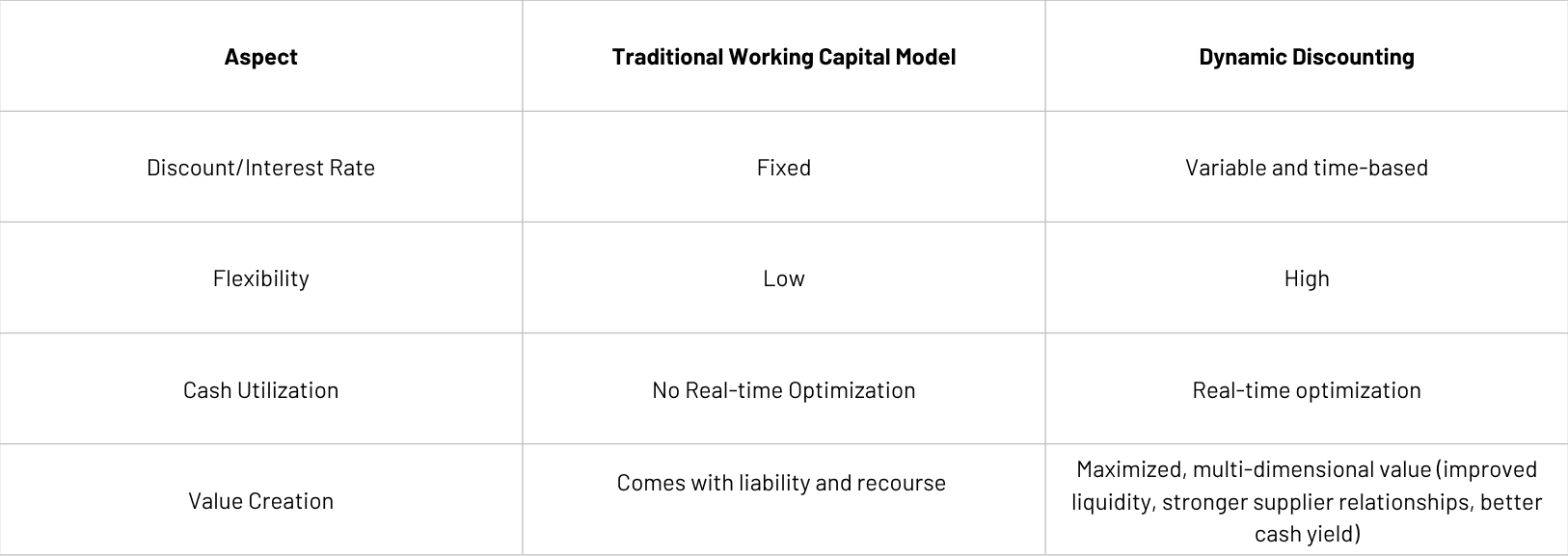
Dynamic discount compared to the traditional early payment model
Dynamic Discounting’s Prioritization in CFOs
Dynamic discounting underpins top strategic goals including the following:
- Enhancing return on capital
- Building greater supplier ecosystems
- Enhanced financial agility
- Driving operational efficiency
It enables CFOs to move beyond cost control and focus on value creation through more effective deployment of existing cash resources. This shift is redefining the role of treasury. In 2026, treasury is no longer just a control function, it is a performance-driven strategy.
The companies that lead are those that:
- Don’t just manage cash passively
- Fund in the right place at the right time
- Connect the treasury with the supply chain strategy
Dynamic discounting sits at the core of this transformation.
It brings together cash, suppliers, and operations into a unified, value-driven framework, enabling smarter liquidity management and long-term impact.
Conclusion
Businesses are using dynamic discounting to rethink working capital.
By promoting early payments, maximizing returns, and building supplier relationships wherever possible, dynamic discounting turns treasury into a more proactive, value-adding part of the mix.
The question is no longer whether organizations will adopt dynamic discounting, but how effectively they can leverage a dynamic discounting provider like Mynd Fintech to make it an integral part of their treasury strategy in 2026 and beyond.
